Résidence à La Solitude du Pré-d'en-Haut (Nouveau-Brunswick, Canada)
2-15 Juillet 2018
(avec l'auteure Hélène Harbec)
Le projet pour la résidence à la Solitude du Pré-d'en-Haut est centré sur une expérimentation du paysage à l’époque de l’Anthropocène, selon une approche « mésologique » de La Solitude de Pré-d’en-Haut. Cette approche suppose l’étude et l’expérimentation des dimensions écologiques, techniques et symboliques du milieu propre à ce lieu singulier de l’Acadie.
En partant du nom "Acadie", dont l'une des origines possibles est l'"Arcadie", je cherche à comprendre le lien entre le pays mythologique inventé par l'Antiquité gréco-romaine (pays mythologique où serait né Zeus, sur le Mont Lycée ; pays où le roi Lycaon fut changé en loup par Jupiter ; et surtout pays de l'âge d'or où la vie pastorale était un paradis sans heurts rythmé par la musique enchanteresse), sa force d'attraction sur les colons français venus en ce lieu transatlantique du "Nouveau Monde", sa rencontre avec le milieu Mi'kmaq (ethnie amérindienne) et ce lieu particulier de solitude, de repos et de méditation dans la "nature" où se situe la résidence.
C'est en quelque sorte la mise entre parenthèses du rêve acadien ancestral (d'où le "(R)" dans A(R)CADIE) qui est questionné, c'est-à-dire quels sont ses restes fantomatiques, ses tentatives de restauration, ce que tout cela signifie à l'époque de l'Anthropocène (en tant que le milieu acadien n'est pas une pure nature, mais bien une écoumène qui s'est d'abord constituée à partir de l'environnement brut selon des techniques humaines de fertilisation des terres via la déforestation et l'aménagement des berges en "aboiteaux" conjuguée à la marée des rivières, et qui s'est ensuite dégradé par les effets d'obstruction des ponts-jetée, de pollution des dépotoirs et de l'activité industrielle.
Le projet se compose de trois volets :
1) imprégnation du lieu et de ses composantes (espaces, matières, végétaux, animaux, lumières, sonorités, traces humaines directes et indirectes, imaginaires et pratiques) par des notes illustrées sur des carnets et des fiches (matériel apporté).
2) dessins au stylo bille bleu (travail autour des rapports d’échelle, des masses, des vides, de points de vue) ; ces dessins confronteront l’expérience du lieu en relation avec les esquisses à la mine de plomb, les images prises par smartphone sur place et par Google Earth avant l’arrivée (matériel apporté).
3) échanges des impressions et imaginaires du lieu (entretiens enregistrés et mis en ligne) et travail in situ en duo avec l’autre artiste résident.e, notamment à partir des éléments naturels disponibles sur le site de la résidence.
La résidence est proposée autour d'une rencontre avec un.e artiste acadien.nne, en l'occurrence, j'aurai le plaisir de travailler avec l'auteure acadienne Hélène Harbec. Primée à maintes reprises pour son oeuvre littéraire, avec Humaine vagabonde, elle signe son cinquième recueil de poésie. Dans cette œuvre, la poète nous transporte dans ses pérégrinations. Humaine vagabonde, elle se remet en route et parcourt physiquement le territoire, souvent le même trajet, cherchant à s’approprier un nouvel espace, désireuse d’être au cœur d’un mouvement tout en assumant la marge. Son but : habiter son corps et marcher pour s’imprégner de vie, franchir les murs, la distance, aller vers l’autre et goûter quelques rares instants de durée. Le travail d’écriture aura donné 134 magnifiques poèmes qui décryptent à merveille le silence de l’humain vagabondage.
https://fr.wikipedia.org/wiki/H%C3%A9l%C3%A8ne_Harbec
Cette résidence est organisée par l’Association acadienne des artistes professionnel.le.s du Nouveau-Brunswick (AAAPNB) et bénéficie des précieuses contributions financières du Conseil des arts du Canada, du Gouvernement du Nouveau-Brunswick et du Consulat général de France dans les provinces atlantiques.
[EN]
A(R)CADIA
An Essay in Graphic Mesology
Residency at La Solitude du Pré-d'en-Haut (New Brunswick, Canada)
July 2-15, 2018
(with author Hélène Harbec)
The project for the residency at La Solitude du Pré-d'en-Haut focuses on an exploration of the landscape in the Anthropocene era, using a "mesological" approach to La Solitude du Pré-d'en-Haut. This approach involves studying and experimenting with the ecological, technical, and symbolic dimensions of the environment specific to this unique Acadian site.
Starting with the name "Acadia," one possible origin of which is "Arcadia," I seek to understand the connection between the mythological land invented by Greco-Roman antiquity (the mythological land where Zeus was supposedly born on Mount Lycaeus; the land where King Lycaon was transformed into a wolf by Jupiter; and above all, the land of the Golden Age where pastoral life was a peaceful paradise punctuated by enchanting music), its power of attraction for the French colonists who came to this transatlantic location in the "New World," its encounter with the Mi'kmaq community (a Native American ethnic group), and this particular place of solitude, rest, and meditation in "nature" where the residence is located.
It is, in a way, the bracketing of the ancestral Acadian dream (hence the "(R)" in A(R)CADIA) that is being questioned—that is, what are its ghostly remnants, its attempts at restoration, What all this means in the Anthropocene era (given that the Acadian environment is not pure nature, but rather an ecumene that was initially formed from the raw environment using human techniques of land fertilization through deforestation and the construction of riverbanks with "aboiteaux" combined with river tides, and which was subsequently degraded by the effects of causeway obstructions, landfill pollution, and industrial activity).
The project consists of three parts:
1) immersion in the site and its components (spaces, materials, plants, animals, light, sounds, direct and indirect human traces, both imaginary and practical) through illustrated notes in notebooks and on index cards (materials provided).
2) drawings in blue ballpoint pen (exploring relationships of scale, mass, voids, and points of view); these drawings They will compare their experience of the site with pencil sketches, images taken on-site with a smartphone, and images from Google Earth before arrival (materials brought by the artist).
3) Exchange of impressions and imaginings of the site (interviews recorded and posted online) and on-site work in pairs with the other resident artist, particularly using the natural elements available on the residency site.
The residency is structured around a meeting with an Acadian artist; in this instance, I will have the pleasure of working with the Acadian author Hélène Harbec. Awarded numerous prizes for her literary work, she presents her fifth collection of poetry, *Humaine vagabonde*. In this work, the poet takes us on her wanderings. A wandering human, she sets off again, physically traversing the territory, often retracing the same route, seeking to appropriate a new space, eager to be at the heart of a movement while embracing her marginality. Her goal: To inhabit one's body and walk in order to absorb life, to cross walls, distance, to reach out to others and savor a few precious moments of existence. The writing process yielded 134 magnificent poems that beautifully capture the silence of human wandering.
https://fr.wikipedia.org/wiki/H%C3%A9l%C3%A8ne_Harbec
This residency is organized by the Acadian Association of Professional Artists of New Brunswick (AAAPNB) and benefits from the generous financial contributions of the Canada Council for the Arts, the Government of New Brunswick, and the Consulate General of France in the Atlantic Provinces.


Canoë votif
Argile et fleurs (env. 40x12x7cm)
Enfoncer les doigts directement dans l'épaisseur de l'argile à peine déposée, modeler sur la rive en ouvrant la terre rassemblée, déposer quelques fleurs prélevée sur la falaise, laisser venir la marée.
De cette chaîne d'opérations simple, rappeler que le peuple Mi'kmaq a vécu ici, a façonné la terre, a prié la rivière, a enterré ses morts, a fleuri ses souvenirs, jusqu'à ce qu'aucune trace ne puisse en témoigner.
Un ex-voto en offrande éphémère, sans divinité assignée, à la manière du vent qui passe et des vagues qui reviennent, sans prétention de répéter un rite ou d'exprimer avec justesse une culture.
[EN]
Press your fingers directly into the freshly laid clay, shape it on the riverbank by breaking up the gathered earth, place a few flowers gathered from the cliff, and let the tide come in.
From this simple chain of actions, remember that the Mi'kmaq people lived here, shaped the land, prayed to the river, buried their dead, and tended their memories, until no trace remained.
A votive offering, an ephemeral tribute, without an assigned deity, like the passing wind and the returning waves, without any pretense of repeating a rite or accurately expressing a culture.


Replanter la forêt
33 arbres morts (épinettes et bouleaux, env. 20x12x3m)
Ramasser des arbres morts blanchis par le soleil et la rivière, sélectionner 33 arbres, d'un geste franc les planter dans l'argile de la berge, laisser venir la marée qui les emporte un par un.
Il fallait compenser le bilan carbone de ce voyage entre la France et le Nouveau-Brunswick par 33 arbres ; sans terrain disponible et sans volonté de déléguer la plantation, impossible de le faire au retour ; donc proposer à la place de symboliser cet échec par une forêt déjà morte, une ombre de ce qui n'aura pas lieu.
[EN]
Gathering dead trees bleached white by the sun and the river, selecting 33 trees, and with a decisive gesture planting them in the clay of the riverbank, letting the tide come and carry them away one by one.
The carbon footprint of this journey between France and New Brunswick had to be offset by 33 trees; without available land and without the will to delegate the planting, it was impossible to do so upon the return; therefore, instead, the proposal was to symbolize this failure with a forest already dead, a shadow of what will not come to pass.


Marée de terre
Argile et bouleau vivant (dimensions variables)
Un arbre couché qui ne tient plus que par quelques racines agrippées à la falaise garde quelques branches vivantes. Les autres branches prennent appui sur le sol, beaucoup sont brisées.
Prendre de l'argile et ajouter des points de contact comme si une marée de terre venait soutenir et nourrir l'arbre encore une saison. La rivière conteste le geste et reprend la terre. L'arbre vivra encore un temps.
[EN]
A fallen tree, held in place by only a few roots clinging to the cliff, retains a handful of living branches. The other branches rest on the ground, many broken.
Take clay and add points of contact, as if a tide of earth were coming to support and nourish the tree for another season. The river resists the gesture and reclaims the earth. The tree will live on for a while longer.


Les spectres. 5 canoës
Argile (env. 50x35x15cm par élément)
Prélever des écailles de boue, les déposer sur la grève au soleil, modeler des canoës en argile sur chaque écaille, les faire sécher au soleil et au vent, trouver un lieu protégé qui rappelle l'accueil bienveillant par les Mi'kmaqs des peuples blancs venus d'Europe : les Vikings, les Irlandais et les Français avant la variole, les missionnaires, les déportations et les exécutions anglaises.
Pas hasard, apprendre ensuite qu'il existe une légende acadienne qui parle de canoës volants...
[EN]
Collect flakes of mud, lay them on the beach in the sun, mold clay canoes on each flake, let them dry in the sun and wind, and find a sheltered spot that evokes the Mi'kmaq's welcoming reception of the white peoples who came from Europe: the Vikings, the Irish, and the French before smallpox, the missionaries, the deportations, and the English executions.
It's no coincidence that I later learned of an Acadian legend about flying canoes...


Le livre des marées
Argile sur papier chiffon (18x24cm)
Un livre de papier aux couleurs des pierres de la grève, heureux hasard.
Refaire la marée avec l'argile déposée, du bout des doigts faire comme la lune et le vent, trois fois attendre et recommencer.
Au bout, le volume semble laissé par le retrait de l'eau.
[EN]
A paper book the color of the beach stones, a happy coincidence.
Recreating the tide with the deposited clay, using fingertips to mimic the moon and the wind, waiting three times and starting again.
At the end, the volume seems to have been left by the receding water.


Série Petitcodiac
Stylo bille sur papier (29,7x42 cm)
Série de dessins réalisés dans la cabane, le soir, après les activités le long de la rivière. À la lampe électrique, par le souvenir et les croquis, tenter de montrer le paysage puissant et tourmenté de la rivière Petitcodiac.
[EN]
A series of drawings made in the cabin in the evenings, after activities along the river. By electric lamp, through memory and sketches, I attempted to depict the powerful and turbulent landscape of the Petitcodiac River.


Msit (Tout)
Pierres bleues (env. 500x400x15cm)
En marchant jusqu'aux confins du domaine de La Solitude, s'émerveiller devant le bleu qui veine les falaises de boue. Ensuite tracer un hiéroglyphe Mi'kmaq (selon Chétien Le Clerq qui a compilé, étudié, systématisé et complété l'écriture Mi'kmaq au 17e siècle) en ramassant, cassant, portant des pierres sur des centaines de mètres pendant 3 jours, laisser la marée tout recouvrir d'eau et de graviers... Pierres céleste devenant sol.
Le titre, Msit, désigne "Tout" en écriture Mi'kmaq.
[EN]
Walking to the edge of the La Solitude estate, marvel at the blue veins that run along the mud cliffs. Then, trace a Mi'kmaq hieroglyph (according to Chétien Le Clerq, who compiled, studied, systematized, and completed the Mi'kmaq script in the 17th century) by gathering, breaking, and carrying stones for hundreds of meters over three days, letting the tide cover everything with water and gravel... Celestial stones becoming earth.
The title, Msit, means "All" in Mi'kmaq script.


Série Limon
Argile et rehauts au crayon sur papier (14,7x21 et 29,7x42 cm)
Série réalisée sur la berge et dans la cabane. Dans une impulsion expérimentale, avec l'argile, la gravité et le vent, laisser venir la rivière sous les doigts, en un seul geste.
Sans assurance, revoir l'ensemble dans la cabane et rehausser de crayons blanc, pour marquer une vague, tirer un trait analytique, inscrire le mot qui vient.
Aucune certitude à l'issue.
[EN]
A series created on the riverbank and in the cabin. In an experimental impulse, using clay, gravity, and wind, I let the river flow beneath my fingers in a single gesture.
Without certainty, I revisited the work in the cabin and added touches of white pencil, to mark a wave, draw an analytical line, and write the word that came to me.
No certainty at the end.


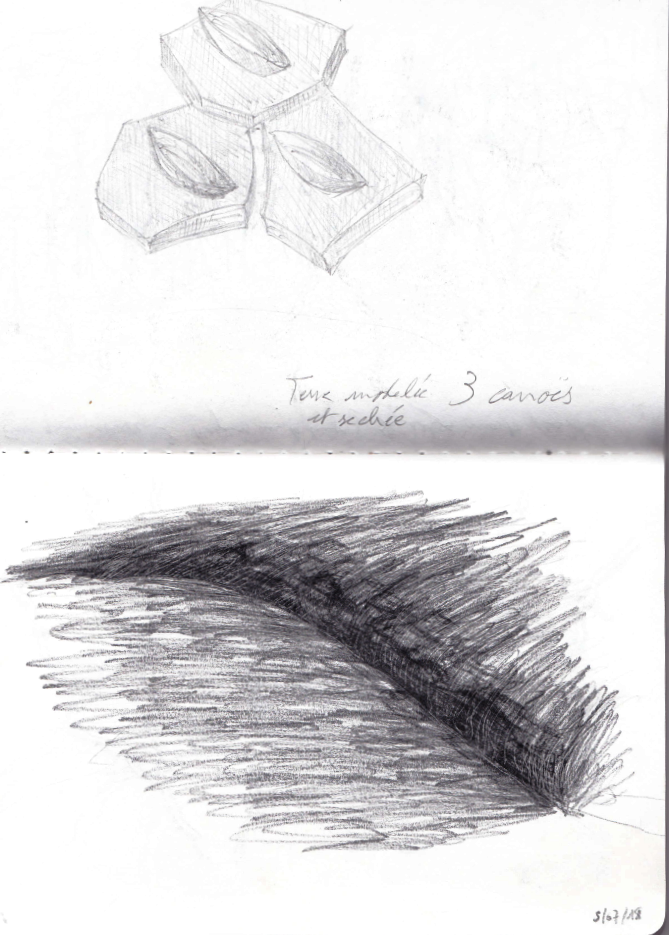
Carnets
Stylo bille sur papier et crayon graphite sur papier
3 carnets : 2 carnets de petit format servant de journal de résidence, principalement écrits, et 1 carnet de plus grand format servant pour les esquisses de projets et les croquis sur le motif.
[EN]
3 notebooks: 2 small notebooks used as a residence journal, mainly written, and 1 larger notebook used for project sketches and sketches on location.